Note from Co-Director Julia Spicher Kasdorf: When people learn of this collaborative effort to uncover the history of Centre County’s nineteenth- and early twentieth-century Black community, they almost always ask where the descendants of that community are now. Daniel Woodruff, an MA student in creative writing, worked this past summer to answer that question, with an eye to the community in Philipsburg. Daniel’s research was supported with a grant from Penn State’s Africana Research Center.
From its founding in 1795 through the mid-twentieth century, Bellefonte provided Centre County with governance, arts and culture, industry, and a steady workforce. Because of the town’s prominence, the Black History in Centre County Project has naturally focused much of its research on the substantial Black community there.
Yet to truly understand the history of Centre County’s Black experience, we must also look to the county’s smaller boroughs. And so, my summer research centered on the boroughs of Philipsburg and adjoining South Philipsburg, where I tracked the names of Black residents enumerated in the 1900 US Census (South Philipsburg was a borough from 1891 until it merged into Rush Township in 2007). Specifically, I sought to discover who remained in Centre County, who moved away, and where they were ultimately laidto rest. After a summer of research, I’ve come away with some telling statistics that point to where these people may have gone. Along the way, I encountered several unforgettable individuals, whose stories I hope to share in the future.
Establishing the Numbers
In 1900, 98 Black residents were recorded in Philipsburg and South Philipsburg, whose combined population was 3,763. I was able to find probable death dates and locations for 82 of those 98 individuals.
A statistical comparison of those who stayed in Centre County versus those who moved away reveals striking generational differences. Of the 82 Black residents I managed to track, nearly two-thirds were ultimately laid to rest outside Centre County. Overcoming this loss of population could have been possible, if not for the fact that those who moved out were among the community’s youngest, as is often the case with outmigration in Northern Appalachia—even today and regardless of race.
Of those who would die outside Centre County, nearly two-thirds were under 31 years of age when the 1900 census was enumerated. The median age of all future “leavers” was 18.5 years. By contrast, the median age of those who would stay was 31. The box plot below illustrates how age at the time of the 1900 Census is related to whether individuals remained in or left Centre County.
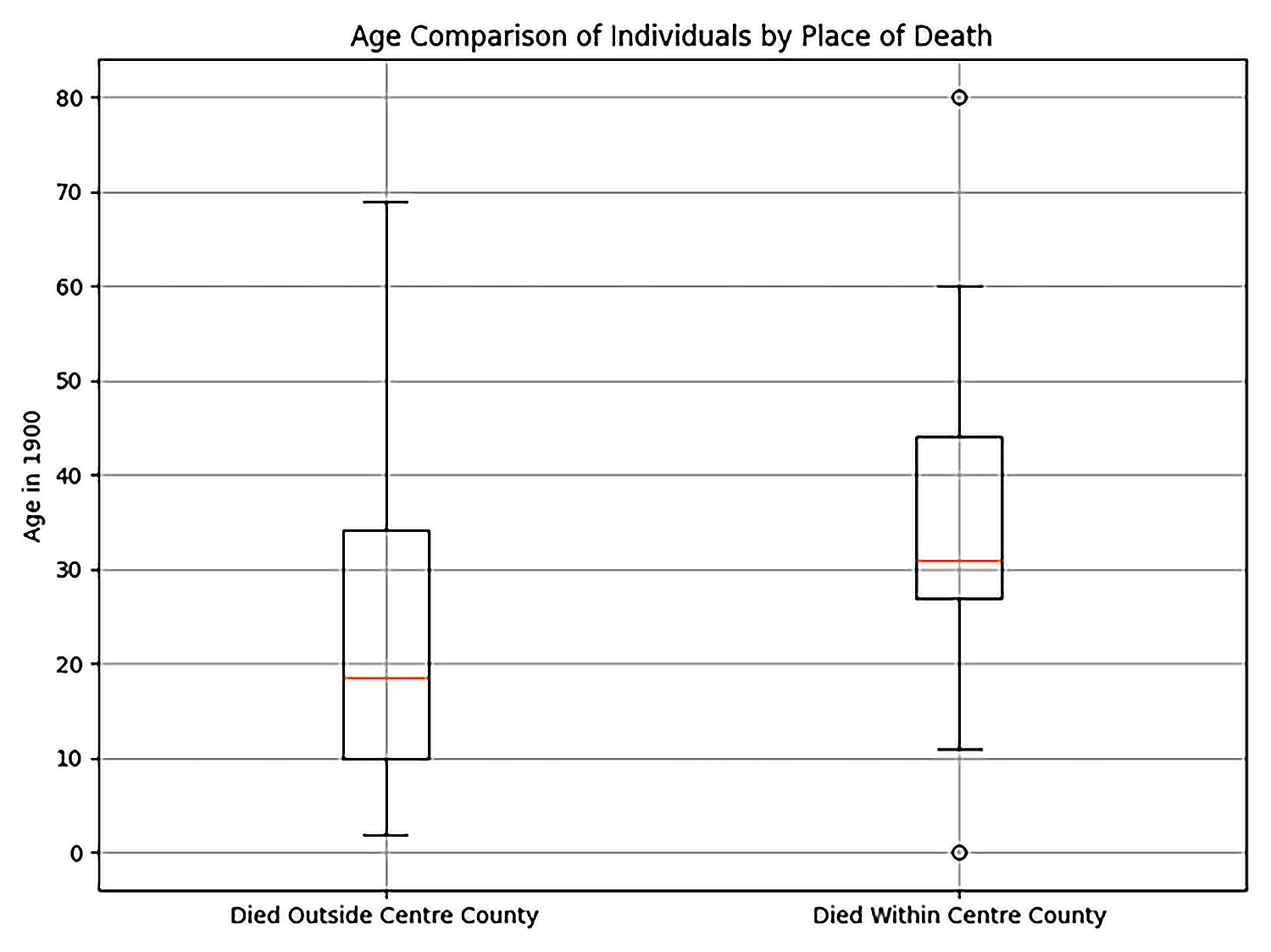
Where did so many of Philipsburg’s and South Philipsburg’s young Black residents go after the 1900 census? And why did they leave Centre County?
To answer the first question, we’ll have to look at some more statistics. The table below builds on the box plot by listing—in order from most to least common—the counties where Philipsburg and South Philipsburg out-migrants eventually died. It also indicates the median ages in 1900 of individuals who later died in each of those counties.
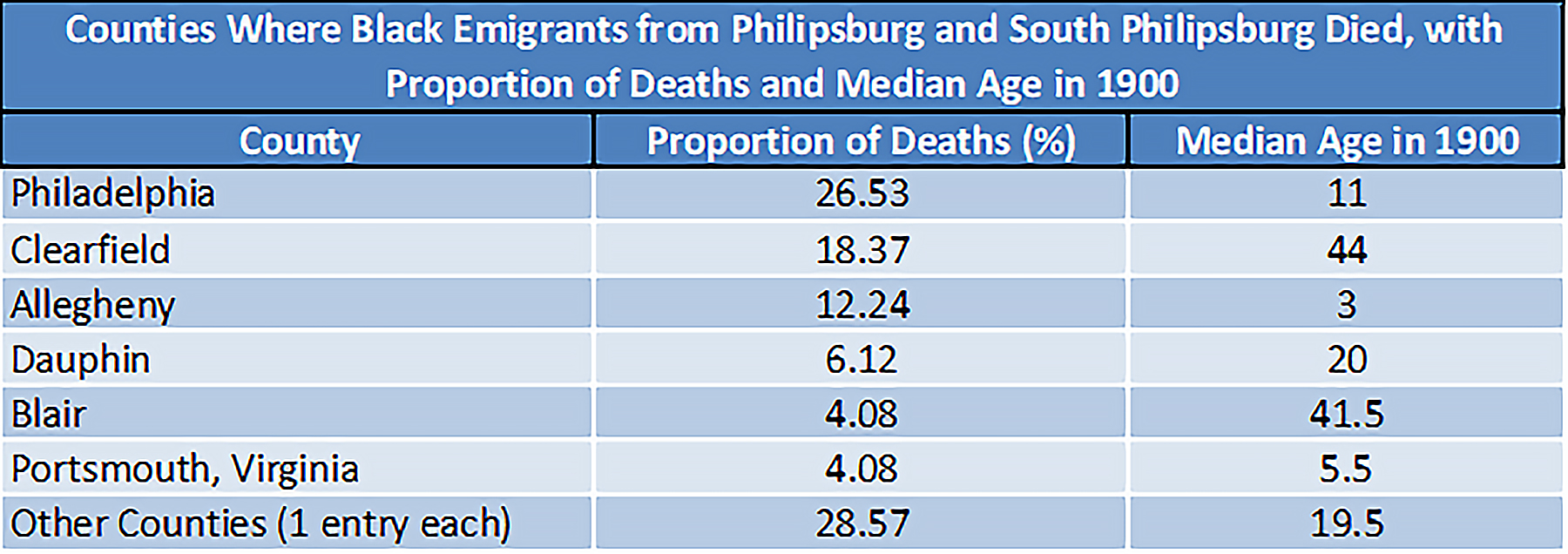
This table confirms two important trends:
1. Younger out-migrants were attracted to cities. Many of them moved to Philadelphia, Pittsburgh, and Harrisburg—burgeoning industrial hubs with large Black communities.
2. Older out-migrants rarely traveled further than a neighboring county, such as Clearfield or Blair (Altoona or Tyrone).
Two Generations, Two Paths
What emerges from this evidence indicates a clear generational split around the turn of the twentieth century.
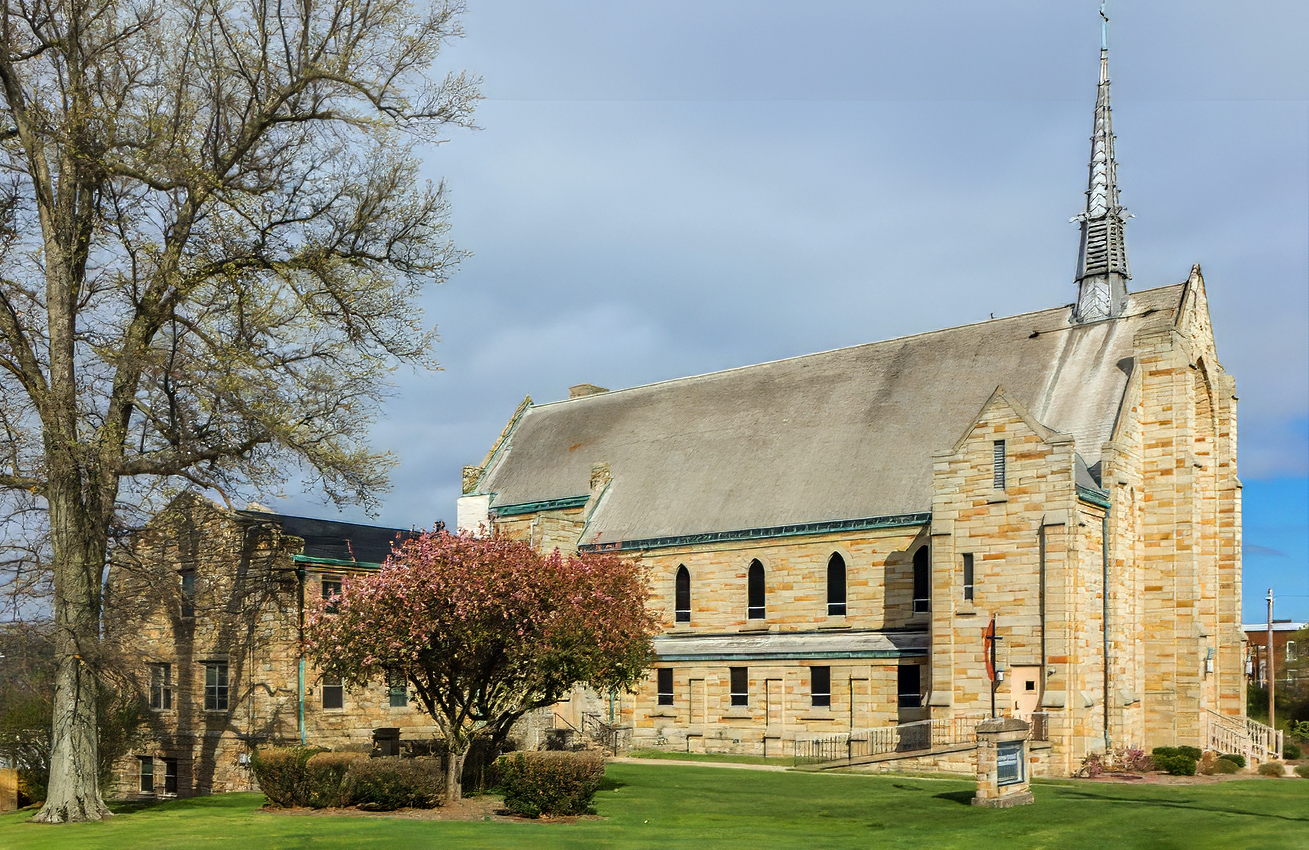
The older generation likely arrived in Philipsburg before or shortly after the Civil War. Some may have been free people who settled in town before the conflict, while others escaped enslavement and sought safety in the North. Still others moved there during Reconstruction in search of opportunity. This group became firmly rooted in the community, working in tanneries, brickyards, coal mines, and logging camps. Some of them organized an African Methodist Episcopal congregation, while others joined Philipsburg’s Trinity United Methodist congregation. They were admired locally for their character and steadfastness, as noted in obituaries and other public accounts.

The younger generation, in contrast, sought possibilities elsewhere. This generation came of age during a time of great economic change, as the ripples of the ongoing Industrial Revolution reached even the most remote Pennsylvania communities. By theturn of the twentieth century, many of Philipsburg’s industrial concerns were struggling to stay afloat in the face of stiff competition from larger firms with greater financial resources and easier access to raw materials.
An especially hard-hit industry was logging. Once among Philipsburg’s leading enterprises, logging companies ran out of woodland to harvest and customers to serve by the early twentieth century (Cramer). The region’s old growth forests had been clear-cut for ship masts, charcoal production, mineshaft props, and other lumber needs.
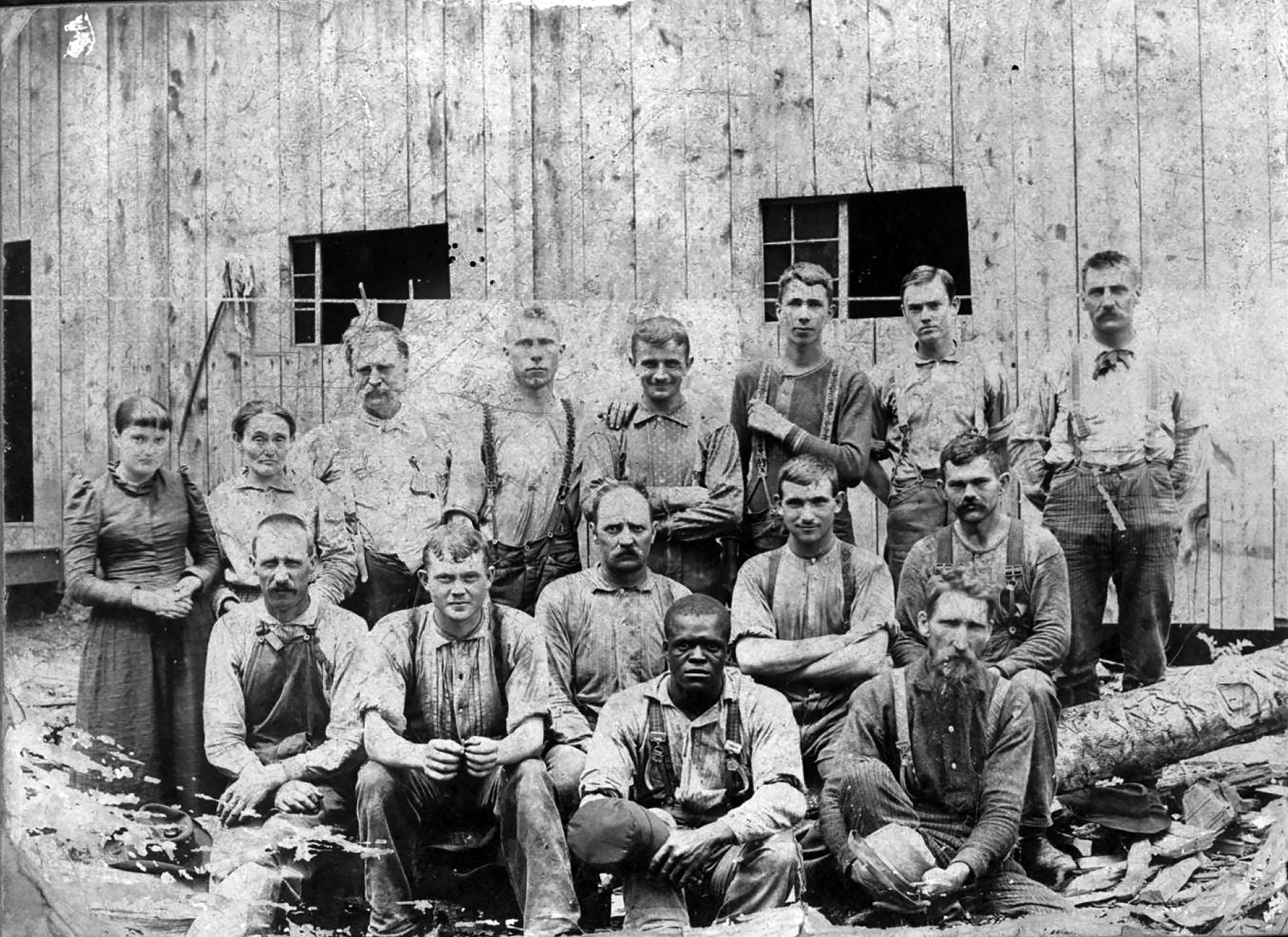
The sudden decline in local jobs was likely a deciding factor for many of Philipsburg’s and South Philipsburg’s young adult people of color. Couple this loss with the general rise in racism in the US during the 1920s, when most of these men and women would have been entering adulthood. (An earlier blog post describes activity of the Ku Klux Klan in Centre County during this period.) It’s easy to infer that whatever new jobs remained in Philipsburg would have gone primarily to white people.
The growing industries in Philadelphia, Pittsburgh, and Harrisburg enticed jobseekers away from Philipsburg. Yet their efforts to build better lives often met with resistanceand hostility in these cities, where the Philipsburg migrants would have been associated with the broader wave of Black migration fleeing Jim Crow violence in the South.
Resilience Across Circumstances
Numbers and trends only tell the general contours of the story. Broad generalizations clearly conclude that the older generation had overcome the legacies of enslavement, the dislocations of the Civil War, and the uncertainties of Reconstruction to forge stable lives in Philipsburg. The younger generation took the risk of leaving home and endured the challenges of industrial cities where racism and meagre resources often made survival itself an accomplishment. The stories of two individual residents of Philipsburg who exemplify these experiences caught my attention during this research: Elijah Only, an escapee of enslavement who stayed in the area, and John Oliver Morrison, a college- educated music teacher who moved away. Their stories deserve a post of their own, which will be told at a later date.
Sources:
Cramer, Ben. “Logging Industry.” Centre County Historical Society, 28 Jan. 2023,
centrehistory.org/article/logging-industry/.